
 Real Korean 2 – Tell & explain1 of 11
Lesson 1
The story of how
Tell how you started with Korean, your job or your hobby, so that someone else can pass it on.
After Real Korean 1 · A2
You can tell a story, explain why, and keep up when Koreans talk casually.
Register interestCourse promise. You can tell a story, explain why, and keep up when Koreans talk casually. This is where 반말 (with friends) and understanding natural speech tempo come in.
Who it is for. Alumni of Real Korean 1 or Conversation Reset, or the equivalent level after a placement call.
Exit level. ACTFL Intermediate Low / CEFR A2 in spoken interaction: past, future, reasons, opinions, first 반말.
Grammar policy. One point per lesson, always introduced after you have tried to express it without it, always practised in speech, never in gap-fill. The tables are in the platform as reference, not homework.
Format. 10 × 75 min on Zoom, max 16 participants. Starts May 2027.
Price. SEK 3,190. Alumni price SEK 2,690 for anyone who has completed a SeoulNova course. All prices include 25% VAT.
Every lesson is 75 minutes in six blocks, identical across courses: retrieval of chunks from earlier lessons, input (the mission presented as a situation, 6–10 chunks, a model dialogue recorded in Korea), pronunciation gym and drill, the mission in pods of 2–4 (round 1), a two-minute interlude where the teacher names one thing that went well and one form to keep in mind, the same mission with a new partner and a complication (round 2), performance in the whole group and finally language focus and the can-do check. Lessons 1–4 build, lesson 5 is halfway (everything from lessons 1–4 again, with complications), lessons 6–8 build, lesson 9 is the dress rehearsal and lesson 10 is the final test. You spend 35 of the 75 minutes in a breakout room. No lesson is a lecture.
The method. The Speak First Method is task-based language teaching: chunks before rules, task repetition with a new partner and spaced retrieval across the weeks. We use 해요체 up to lesson 4, where 반말 with friends comes in, and let you speak without particles, just as Koreans do in everyday life. Grammar is explained only when the mission needs it.
Homework (15 min/day, in the platform): shadow the model dialogue, spaced repetition of chunks with audio, a 60-second micro-mission and an optional culture clip. No written grammar exercises.
Three measuring points: a 60-second recording before lesson 1 and after lesson 10 (same prompt), a can-do checklist with one statement per lesson that you tick off and the teacher confirms, and a 6-minute oral final test graded on task completion, intelligibility, language resources and fluency. Grammatical accuracy is not a criterion. You receive a course certificate with level, can-do list and test result, shareable as a link.
Real Korean 2 – Tell & explain1 of 11Lesson 1
Tell how you started with Korean, your job or your hobby, so that someone else can pass it on.
 Real Korean 2 – Tell & explain2 of 11
Lesson 2
Explain reasons, give examples and follow up other people's explanations.
 Real Korean 2 – Tell & explain3 of 11
Lesson 3
Ask for and give advice with conditions: if you like it spicy, try …
 Real Korean 2 – Tell & explain4 of 11
Lesson 4
Switch to 반말 with friends your own age, and know when not to.
 Real Korean 2 – Tell & explain5 of 11
Lesson 5
Lessons 1–4 as a chain: tell, explain why, give advice, and choose the right speech level.
 Real Korean 2 – Tell & explain6 of 11
Lesson 6
Follow a K-drama clip or a friend's fast story and summarise it.
 Real Korean 2 – Tell & explain7 of 11
Lesson 7
Compare cultures with nuance: food, work, fika versus 회식.
 Real Korean 2 – Tell & explain8 of 11
Lesson 8
Talk about a misunderstanding or an embarrassing situation, and what you learned.
 Real Korean 2 – Tell & explain9 of 11
Lesson 9
Dress rehearsal: ten minutes of recorded conversation in pairs, with questions the guest has not seen.
 Real Korean 2 – Tell & explain10 of 11
Lesson 10
The 6-minute oral test in pairs, your "after" recording and the certificate.
Real Korean 2 – Tell & explain
Your turn
No sessions are open yet. Leave your e-mail and we will let you know when you can pick a time.
Register interestSituation. Someone wants to know how you really started with Korean, with your job or with your hobby, and wants the whole story, not just an answer.
Can-do. I can tell how I started with Korean, my job or my hobby in 8–10 sentences.
Key language. 처음에는 · 그때 · -기 시작했어요 · -(으)ㄴ 후에
Grammar in flow. Time clauses. -기 시작하다.
Pronunciation gym. Tempo in long turns: pause on phrases, not words. 처음에는 / 한국 드라마를 / 봤어요
The mission. Tell your origin story so that your partner can retell it to a third person who has not heard it.
Why. A story from your own life is the topic that produces the most speech, and when someone else retells it, it has been produced twice.
Situation. A journalist interviews you: why Korean, why that particular job, why do you live where you live? Every answer needs a reason and an example.
Can-do. I can explain reasons and give examples, and follow up other people's explanations.
Key language. -기 때문에 · 예를 들면 · -(으)니까
Grammar in flow. Reason connectors.
Pronunciation gym. Palatalisation, ㄷ/ㅌ + 이: 같이 [가치], 굳이 [구지].
The mission. Answer the journalist's five questions with a reason and an example, so that the note-taker can write down five reasons in your words.
Why. "Why" is the question that forces longer turns, and the connectors come only after you have tried to explain with just 그래서.
Situation. A friend is going to Korea for a week and has a budget, an allergy and an interest. Two friends who have lived in Korea give tips that suit her.
Can-do. I can ask for and give advice (restaurant, trip, course) with conditions.
Key language. -(으)면 · -는 게 어때요? · -아/어 보세요
Grammar in flow. Conditions. Suggestions.
Pronunciation gym. Intonation in suggestions: -는 게 어때요? rises.
The mission. Give the traveller three pieces of advice, one per condition, with -(으)면.
Why. Advice with a condition is the first grammar that needs two clauses in one breath, and the adviser knows things about the place that the person asking does not.
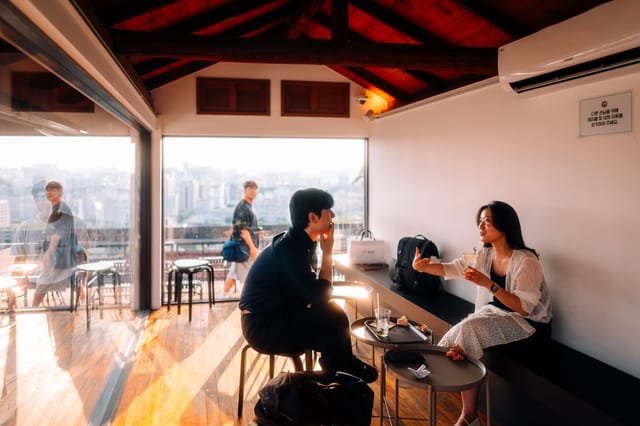
Situation. You and a friend your own age are making small talk in 반말. After two minutes a colleague joins the conversation, and you have to hear from how they speak whether the tone should change.
Can-do. I can switch to 반말 with friends my own age and know when not to.
Key language. -아/어 · 뭐 해? · 밥 먹었어? · 진짜?
Grammar in flow. 반말 endings. Social rules: 나이, 선배/후배.
Pronunciation gym. The same sentence in 반말 and 해요체, two melodies: 뭐 해? / 뭐 해요?
The mission. Speak 반말 with your friend, and notice from the person who joins when you should switch to 해요체.
Why. Misused 반말 costs more socially than 반말 left out, so the core is "when not": there is always someone in the room that 반말 is wrong towards.
Situation. Halfway. A story travels in a chain: you tell it and why it turned out that way, your partner passes it on and adds a piece of advice, and a third person asks questions at their speech level.
Can-do. I can tell a story, explain why and give a piece of advice in sequence, and choose the right speech level for the person I am talking to.
Key language. Nothing new. Retrieval is ten minutes and mixes lessons 1–4.
Grammar in flow. Nothing new. Language focus takes the recurring mistakes from lessons 1–4.
Pronunciation gym. Mixed from lessons 1–4.
The mission. Pass the story on with a piece of advice, and choose the right speech level for the person you tell it to.
Why. Lessons 1–4 come back as a chain, not four tasks: the same content in three forms, and the choice of speech level is what is measured. After the lesson the teacher goes through your can-do list.
Situation. You have each watched a 30-second clip from the same scene, twice with headphones. Nobody has seen the others' clips, and the scene does not hold together until everyone has told theirs.
Can-do. I can follow a K-drama clip or a friend's fast story and summarise it.
Key language. Contractions (것을 → 걸, 이것은 → 이건), discourse markers.
Grammar in flow. Listening strategies. Contractions.
Pronunciation gym. Contractions in fast speech, say them yourself to hear them: 것을 → 걸, 이것은 → 이건, -지요 → -죠.
The mission. Summarise your clip for the others so that the pod can write the whole scene in the right order.
Why. Listening at natural tempo is what alumni most often say they lack, and saying the contractions yourself is the fastest way to start hearing them.
Situation. A Korean friend who has never been to Sweden asks about Swedish everyday life: fika, work, weather, food, weekends. You compare with Korea, with nuance.
Can-do. I can compare cultures (food, work, fika versus 회식) with nuance.
Key language. -보다 · -는 반면에 · 비슷해요 · 달라요
Grammar in flow. Comparison. Contrast.
Pronunciation gym. Stress on contrast: 한국은 … 스웨덴은 …
The mission. Answer your friend's questions so that they can write down three differences and two similarities in your words.
Why. Comparison is the topic where you have the most to say and the Korean the most to ask about, and a friend who has never been to Sweden forces nuance instead of "good/bad".
Situation. Something went wrong in Korea: a wrong order, the wrong train, a misunderstood time. Now it is a story with background and a point, and your friend wants to know what you learned.
Can-do. I can talk about a misunderstanding or an embarrassing situation and what I learned.
Key language. -았/었는데 · -(으)ㄹ 뻔했어요 · 다행이에요
Grammar in flow. -는데 as background.
Pronunciation gym. ㅎ weakening between vowels: 좋아요 [조아요], 많이 [마니].
The mission. Tell what went wrong so that your partner can retell background, mishap and lesson in three sentences.
Why. The Survival situations come back as a story with a point, and -는데 comes when you have already been telling stories for seven weeks without it.
Situation. Dress rehearsal. A podcast episode in pairs: host and guest, ten minutes on a topic the guest chose, with questions the guest has not seen. Published in the alumni community if you want.
Can-do. I can hold a 10-minute conversation on a topic of my choice and answer unexpected questions.
Key language. Everything.
Grammar in flow. Nothing new.
Pronunciation gym. Free switching.
The mission. Record a podcast episode in the platform where you keep the conversation going for ten minutes, even when the question is unexpected.
Why. A recorded conversation on your own topic is the course's mastery moment in the format of the final test, and the teacher takes you for a 3-minute conversation and names one strength and one thing to work on before lesson 10.
Situation. The final test: 6 minutes in pairs with the teacher. Personal information, two role plays where you both answer and take the initiative, and a 30-second long turn after 30 seconds of preparation. While the pairs are tested, the podcast runs again, on a topic you did not choose yourselves.
Can-do. I can show that I tell a story, explain why and keep up when it gets fast.
Key language. Nothing new.
Grammar in flow. None.
Pronunciation gym. None.
The mission. Keep the podcast going on the topic on the card while the teacher tests the pairs.
Why. The test is graded on task completion, intelligibility, language resources and fluency, not on grammar, and the preparation time before the long turn gives you more complex language. Afterwards: your after recording, a certificate with can-do list and test result, and the next step: Conversation Pro at the alumni price and Speaking Club.
Michelle
Head teacher and course lead
No sessions are open yet. Leave your e-mail and we will let you know when you can pick a time.