
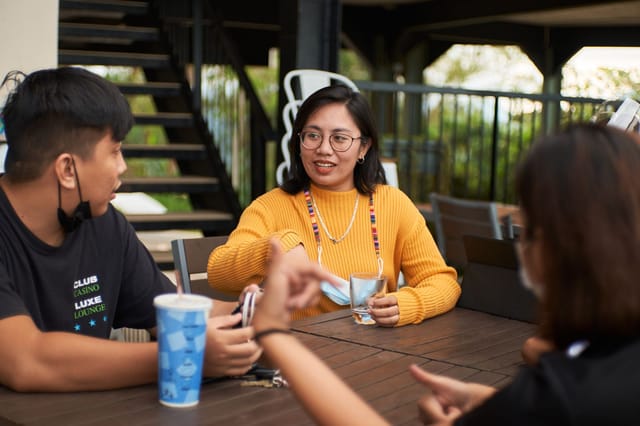
 Conversation Reset1 of 11
Lesson 1
Say something – now
Start without planning: the 3-second rule.

Studied before but freeze · A1+
You already know more Korean than you think. After 10 weeks you use it: you don't freeze, you say something, and you understand the answer.
Register interestCourse promise. You already know more Korean than you think. After 10 weeks you use it: you don't freeze, you say something, and you understand the answer.
Who it is for. You have 50–200 hours of study behind you (Sejong, university, Duolingo, TTMIK, K-drama) but no speaking habit. The same eight situations as Survival Korean, but the missions are open – no script, no given chunks. The focus is on strategies (starting, keeping going, repairing, ending) and on activating your passive vocabulary. The grammar points are "defrosting" things you have already read.
Why the course exists. If you have studied but freeze, your knowledge is stored as rules and words, not as speech: it is not retrieved fast enough for a conversation. What moves knowledge into speech is lots of simple production under time pressure, not more grammar. Freezing is also fear, and it drops with small groups, predictable tasks and permission to hesitate in Korean. Hence max 12, hence fillers in lesson 1, hence daily voice memos to people you know.
Placement included. A 5-minute Zoom conversation (introduce yourself, two role-play prompts) and a can-do self-assessment. Requirements: you read Hangul, recognise 해요체 and know about 300 words passively. Anyone below the benchmark is referred to Survival Korean, anyone above it to Real Korean 2. Placement is free.
Exit level. ACTFL Novice High: your own sentences, follow-up questions, repair.
Homework. Daily 2-minute voice memos in the platform ("tell us one thing about your day"). The teacher listens to the three people in that week's rotation and answers; pod mates are encouraged to answer each other by voice in the cohort group. Plus shadowing three short K-drama clips a week.
Final test. A 10-minute conversation with a Korean guest, graded on task completion, conversation strategies, intelligibility and fluency.
Format. 10 × 75 min on Zoom, max 12 participants per cohort. Starts the week of Monday 25 January 2027, 10 weeks.
Price. Introductory price SEK 2,990 for the January–March 2027 cohorts. Regular price SEK 3,390 from April 2027. Alumni price SEK 2,990 for anyone who has completed a SeoulNova course. All prices include 25% VAT.
Every lesson is 75 minutes: warm-up, the strategy in focus, an open mission in your speaking pod (round 1), a two-minute interlude where the teacher names one thing that went well and one form to think about, the same mission with a new partner and a complication (round 2), whole-group conversation and finally language focus and the can-do check. Lessons 1–4 build, lesson 5 is halfway (everything from lessons 1–4 again, with complications), lessons 6–8 build, lesson 9 is the dress rehearsal and lesson 10 is the final test. No scripts and no given phrases – you activate what you already know.
Conversation Reset1 of 11Lesson 1
Start without planning: the 3-second rule.
 Conversation Reset2 of 11
Lesson 2
Follow-up questions and backchannelling.
 Conversation Reset3 of 11
Lesson 3
Turn a transaction into a conversation.
 Conversation Reset4 of 11
Lesson 4
Say you did not understand, ask for a rephrase, guess.
 Conversation Reset5 of 11
Lesson 5
All four strategies in one conversation, half the final test.
 Conversation Reset6 of 11
Lesson 6
Past tense in speech and sequencing words.
 Conversation Reset7 of 11
Lesson 7
Opinions, agreeing, disagreeing politely.
 Conversation Reset8 of 11
Lesson 8
Phone: no body language, formal opening.
 Conversation Reset9 of 11
Lesson 9
Dress rehearsal: a language café in the form of the final test.
 Conversation Reset10 of 11
Lesson 10
Ten minutes with a Korean guest, your after recording and the certificate.

Conversation Reset
Your turn
No sessions are open yet. Leave your e-mail and we will let you know when you can pick a time.
Register interestStrategy. The 3-second rule: start without planning.
Can-do. I can answer a question within 3 seconds with something, even if it is incomplete.
Activates. 안녕하세요 routines · 이에요/예요 · 있어요/없어요
Language focus. Fillers: 음 · 그니까 · 잘 모르겠어요. Hesitating in Korean is Korean too.
The mission. Quick interview in pairs: ten questions you have not seen, three seconds to answer, your partner counts the silences.
Why. Whoever plans a whole sentence before saying anything goes quiet; fillers buy time without breaking the conversation, and the goal is for the silence before the answer to shrink, not for the answer to be right.
Strategy. Follow-up questions and backchannelling.
Can-do. I can ask three follow-up questions to an answer and show that I am listening.
Activates. Question words: 어디 · 언제 · 누구 · 왜 · 어떻게 · 네 / 아 / 정말요
Language focus. 왜요? · 어떻게요? · 그래서요? as the engine of conversation.
The mission. A tells one thing, B may not change the subject until three follow-up questions have been asked, C listens for them.
Why. A conversation does not die from a lack of words but from a lack of questions: three follow-up questions make the listener the one who drives, and an 아 or 정말요? is what makes a Korean conversation partner keep going.
Strategy. Turn a transaction into a conversation.
Can-do. I can order and then make small talk with the staff about the food, the weather and where I come from.
Activates. Food words · 맛있어요 · 매워요 · 추천
Language focus. -(으)ㄴ/는 것 좋아해요 · -고 싶어요
The mission. Order from the 사장님 and find out three things about the restaurant that are not on the menu.
Why. The same situation as in Survival Korean, but the task is open: what is not on the menu can only be had through conversation, and that is the difference between learned phrases and your own sentences.
Strategy. Say you did not understand, ask for a rephrase, guess.
Can-do. I can repair a misunderstanding in Korean without switching to English.
Activates. 뭐라고요? · 다시요 · [word]이 무슨 뜻이에요? · 그러니까 …
Language focus. Rephrasing phrases: 그러니까 ("so you mean …").
The mission. Your partner deliberately uses three words you do not know. Get through without English.
Why. Repair is what separates a conversation that continues from one that ends in English, and asking for a rephrase and confirming is the very place where learning happens.
Strategy. All four in one conversation: start within 3 seconds, keep going with follow-up questions, expand, repair.
Can-do. I can hold a 5-minute conversation with someone I do not know without switching to English.
Activates. Everything from lessons 1–4.
Language focus. The two or three things that made conversations stall in lessons 1–4.
The mission. Five minutes with a stranger you only know where you meet; then you swap.
Why. The first time the strategies are used together and against the clock: five minutes is half the final test, and whoever has done the test's form in miniature is less nervous when it counts. The teacher checks the can-do list, and the NPS survey goes out after the lesson.
Strategy. Past tense in speech, sequencing words.
Can-do. I can say what I did at the weekend in 5–6 sentences and answer questions about it.
Activates. -았/었어요 (read before, rarely used) · 그리고 · 그 다음에
Language focus. Past-tense conjugation in flow, not in a table.
The mission. Three pictures only you see: tell your weekend so that your partner can retell it.
Why. The past tense is the grammar you know best and use least; the pictures force storytelling, and the conjugation becomes automatic by being used, not by being explained.
Strategy. Opinions, agreeing, disagreeing politely.
Can-do. I can say what I think of a K-drama, a song or food and why, and react to other people's opinions.
Activates. 좋아요 / 별로예요 · -(으)ㄴ 것 같아요 · 저도요 / 저는요
Language focus. -아서/어서 as a conversation tool, not as a table.
The mission. Three in the pod, everyone speaks: rank five things on your own and agree on a top 3.
Why. Exchanging opinions towards a shared goal is the task that gives the most speech per person, because everyone has to say something and someone disagrees.
Strategy. Phone: no body language, formal opening.
Can-do. I can call a restaurant or hairdresser and book a time, and can take a call and understand it.
Activates. 여보세요 · 예약하고 싶어요 · 몇 분 · 몇 시
Language focus. Phone routines. 합쇼체 to recognise, not to produce.
The mission. Cameras off. Call and book a time that actually exists in the booking book only the other person sees.
Why. Without a face and gestures it is pure listening and pure repair, the hardest variant of the same strategies, placed late in the course when they have settled.
Strategy. A continuous conversation with someone you did not choose.
Can-do. I can hold a 10-minute conversation in Korean with someone I do not know.
Activates. Everything from lessons 1–8.
Language focus. Whatever made the conversations stall. You get one strength and one thing to work on before lesson 10.
The mission. Language café: rotation with the teacher and your classmates, ten minutes per conversation, in the form of the final test.
Why. The dress rehearsal is the test without the guest: whoever has done the test's form once performs better and is less nervous the second time, and you know what band 2 means before it counts.
Strategy. Everything, with someone you have never met.
Can-do. I do not freeze: I say something, and I understand the answer, with a stranger too.
Activates. Everything.
Language focus. Nothing new. The course ends with one strength and one thing to work on per student.
The mission. The final test: ten minutes with a Korean guest, graded on task completion, conversation strategies, intelligibility and fluency. While you wait, your pod does lesson 7's task with a new list.
Why. The guest is a real stranger, and that is what the course promises. The after recording next to the before recording is the proof. Then a certificate with can-do list and test result, Real Korean 2 at the alumni price and an invitation to Speaking Club.
Michelle
Head teacher and course lead
No sessions are open yet. Leave your e-mail and we will let you know when you can pick a time.